Blood in Urine
Visible blood in your urine always needs to be investigated — prompt, thorough assessment (haematuria) in Johannesburg.
Don't wait
Visible blood in the urine — even once, even if it goes away, even if nothing hurts — always needs to be investigated. This applies to women just as much as to men. Most causes turn out to be benign, but painless visible blood is also the classic first sign of bladder and kidney cancers, which are far more treatable when found early. The most common mistake is waiting to see if it happens again.
Smokers and ex-smokers should be especially careful: tobacco smoking is the most important risk factor for bladder cancer, accounting for about half of all cases (EAU Guidelines, 2026).
Common causes
- Urinary tract infection — usually with burning and frequency
- Kidney or bladder stones
- Benign prostate enlargement
- Blood-thinning medication — which can reveal an underlying problem, so it still needs checking
- Bladder or kidney cancer — the reason we never ignore it
How it is investigated
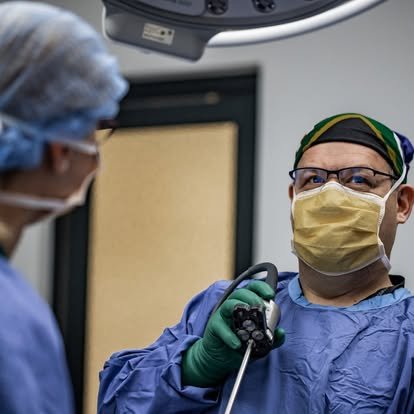
The work-up is quick and thorough, and is designed either to find the cause or to rule out the serious ones:
- Urine tests — to check for infection and other clues
- An ultrasound in the rooms — often done at your first visit
- A CT scan of the kidneys and ureters — preferred, because it shows the whole upper urinary tract, where ultrasound can miss small problems
- A cystoscopy — a look inside the bladder with a fine telescope, done in theatre as a short day procedure
Blood found only on a urine dipstick, without any visible change (microscopic haematuria), also deserves attention if it persists — mention it rather than filing it away. Related: Kidney Stones · Prostate Enlargement
If a bladder tumour is found
Most bladder tumours found early are confined to the lining of the bladder and can be treated without removing the bladder.
- Removal through a telescope (TURBT): the tumour is removed through the urethra, with no cuts on the skin. I usually remove it en bloc — in one piece — which gives the pathologist the best sample to judge how deep it goes and plan what comes next.
- BCG treatment: where needed, I give BCG treatments into the bladder myself, to lower the chance of the tumour coming back or progressing.
- Regular check cystoscopies follow, because bladder tumours can recur.
- Specialist oncology: if chemotherapy or radiation is needed, I refer you to an oncologist and stay involved in your care.
If you have seen blood in your urine, book this week, not next month. If you are passing clots and cannot pass urine, go to your nearest emergency unit straight away. Call 011 794 3549 or email appointment@urology.joburg.
This information is general in nature and is not a substitute for a consultation.